Oscars AIWebsites for businesses that live on enquiries · Oxford

Find what's costing you customers online.Fix it. Run the boring bits.

For brokers, couriers, clinics, trades and agents. One person, not an agency.

The audit. What a customer meets, checked the way they meet it.

Five things, looked at the way a customer would: on a phone, in a hurry, from a search. What comes back is a list, worst first, in plain English, with the fix next to each. Yours to keep.

  1. GoogleWhether you show up for what you sell, where you sell it. Your profile, where they search, with the reviews you have earned.
  2. The phoneWhat a customer actually gets, menu to footer, on the screen they are holding. Most sites are only ever looked at from the office.
  3. The lawCookies, privacy, terms, who you are. Nothing tracks anyone before they said yes. The fines are real, and they land on the owner.
  4. The codeDead links, broken buttons, fonts that never arrive, numbers left over from the last rebuild. The small breaks that lose the sale quietly.
  5. SecurityWhat loads from whom, what is sent where, whether the door is locked. And if you want the certificate, Cyber Essentials, the government-backed one, done with you. I've taken my own company through it.

On the retainer, a real browser opens the site every morning and runs its checks again.

medrics, designed and coded by Giles

Why this one matters.

Patient information is the leaflet you are handed after a diagnosis and the page you find at two in the morning. Six in ten working-age adults do not routinely understand it, and the same condition comes with very different information depending on the postcode. That is a health inequality, and it can be measured.

So I designed and coded medrics to measure it. The system reads every leaflet twenty-two NHS trusts publish, more than twelve thousand eight hundred of them, and asks the same three questions of each: is it up to date, is it readable, can a patient reach it. Out comes one score out of 100 for every region measured in full.

The scores are public. Every trust gets a monthly report of what is out of date, hard to read or missing on its own pages, benchmarked against the others, with the fixes. The clinician picker that hands a patient the right leaflet is free.

That is the discipline behind everything on this page: read all of it, measure it the same way every time, then check again.

12,800+
leaflets read
22
NHS trusts
Monthly
every leaflet, read again
1 score
out of 100, for each region measured in full
22 trusts, one column each · score out of 100well informed

Every patient, properly informed.

Every NHS trust writes its own patient information. Twelve thousand eight hundred leaflets across twenty-two trusts, each one written on its own.

So I designed and coded the system that reads all of it. Every leaflet, every month: is it current, is it readable, can a patient find it at all. Out comes one score out of 100 for each region. That system is medrics.

The difference between one part of the country and the next stops being a feeling and becomes a number. Every trust gets a monthly report of what to fix. Your site gets the same care.

An illustration. The real scores are at medrics.co.uk: 12,800 leaflets, 22 trusts, one score per region.

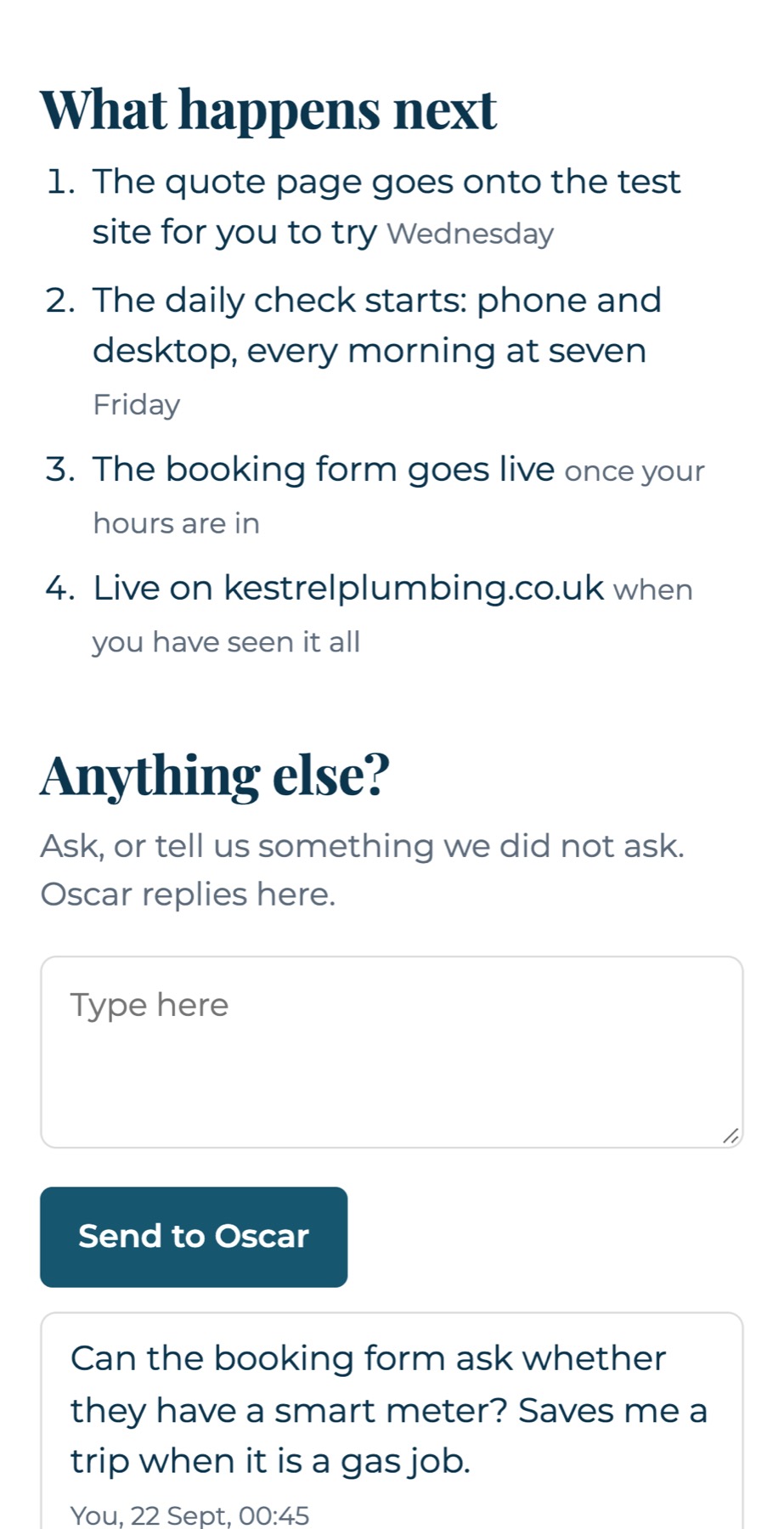
What happens next: four lines, each with a day

Same site. Same photos. Same words.

First, the audit. What's costing you customers, worst first, on the phone your customers use.

Then the fix. I don't replace a site its owner likes. I mirror it, put back what's broken and add what's missing, inside its own design.

Then I watch it every morning. On the retainer, a real browser opens the site every morning, phone and desktop, and runs the checks. I hear about it only when one fails.

Nothing of a client's site is on this page. Their before-and-after lives on their own page, behind a link only they hold. What you see here is that page, for an invented client.

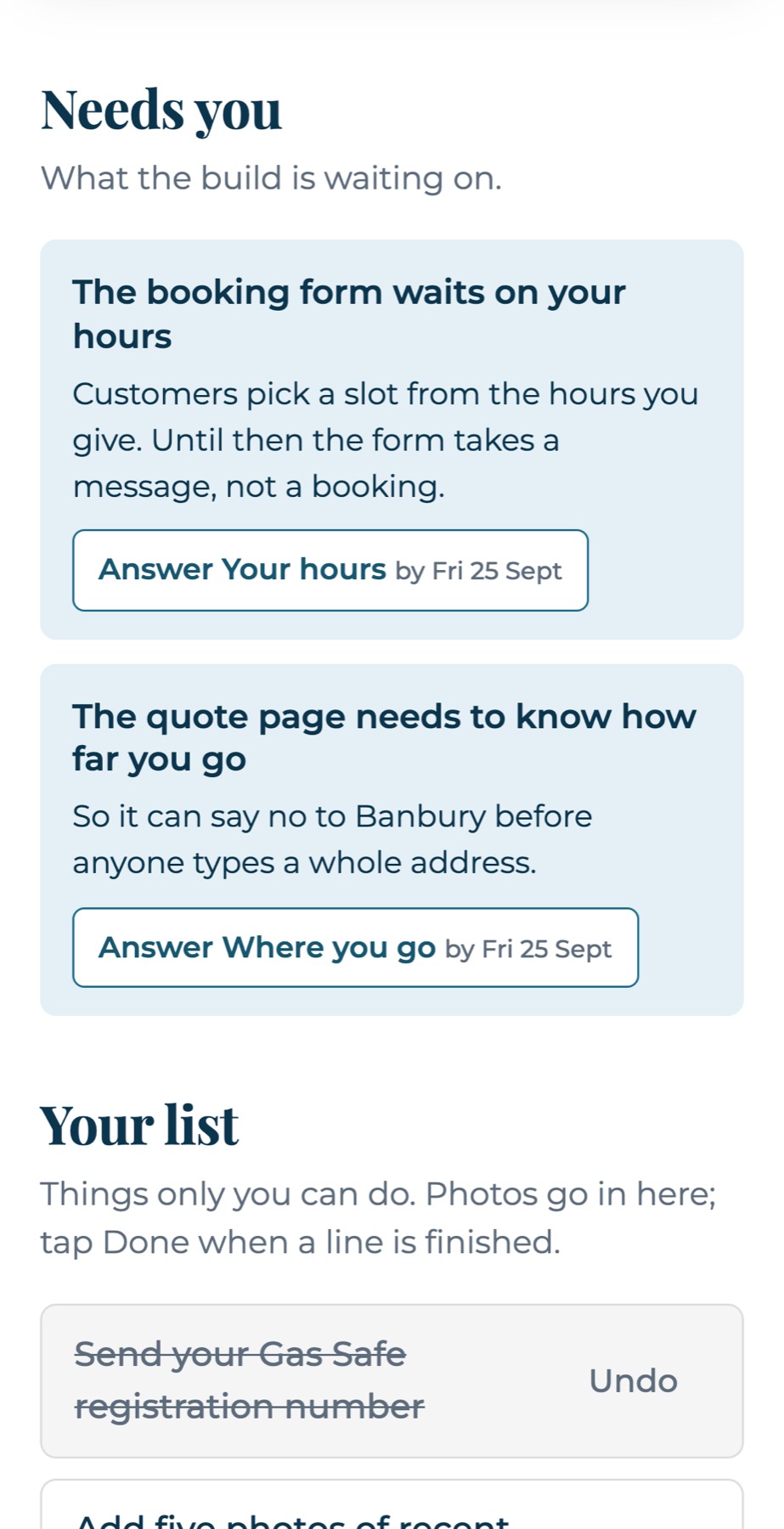
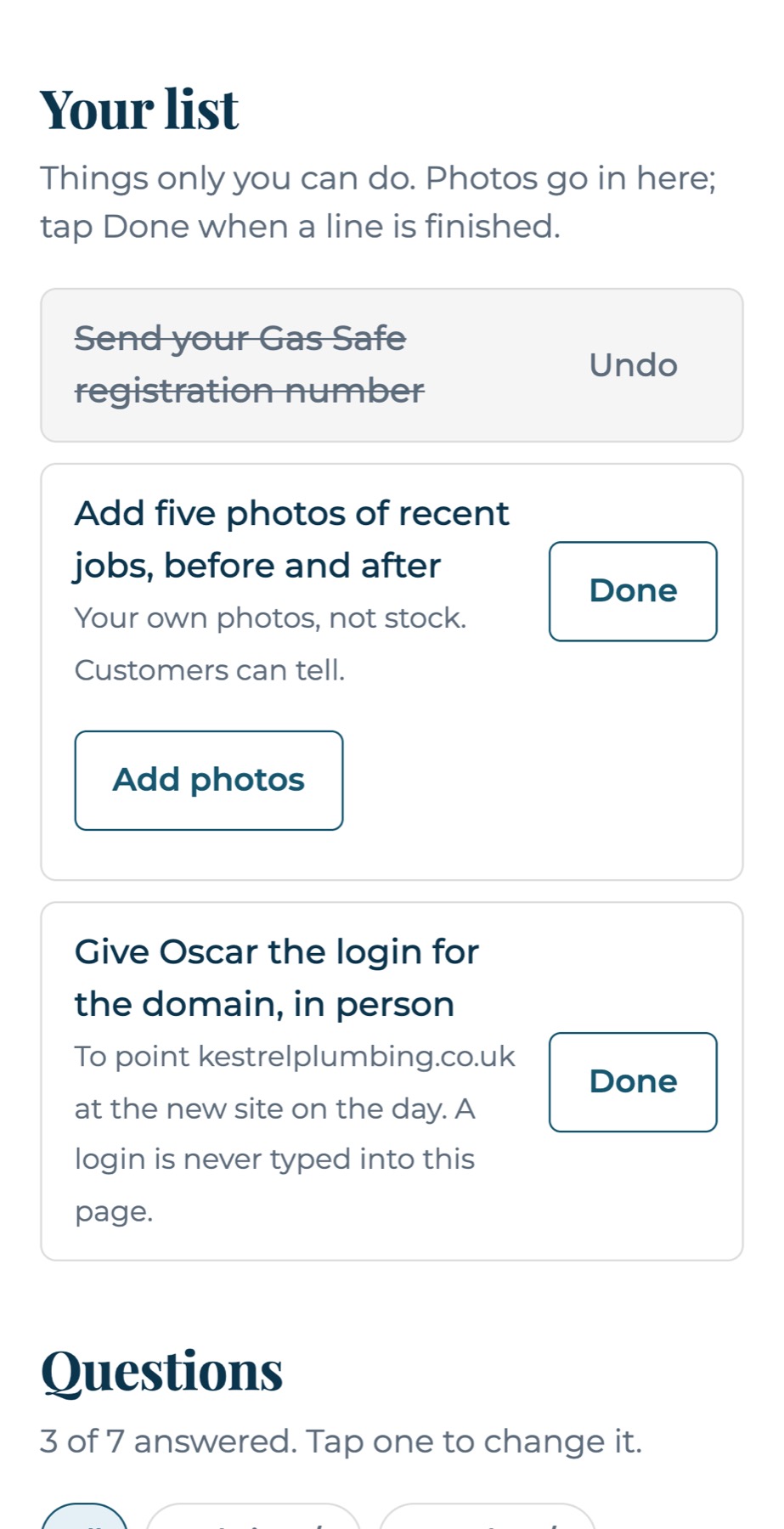
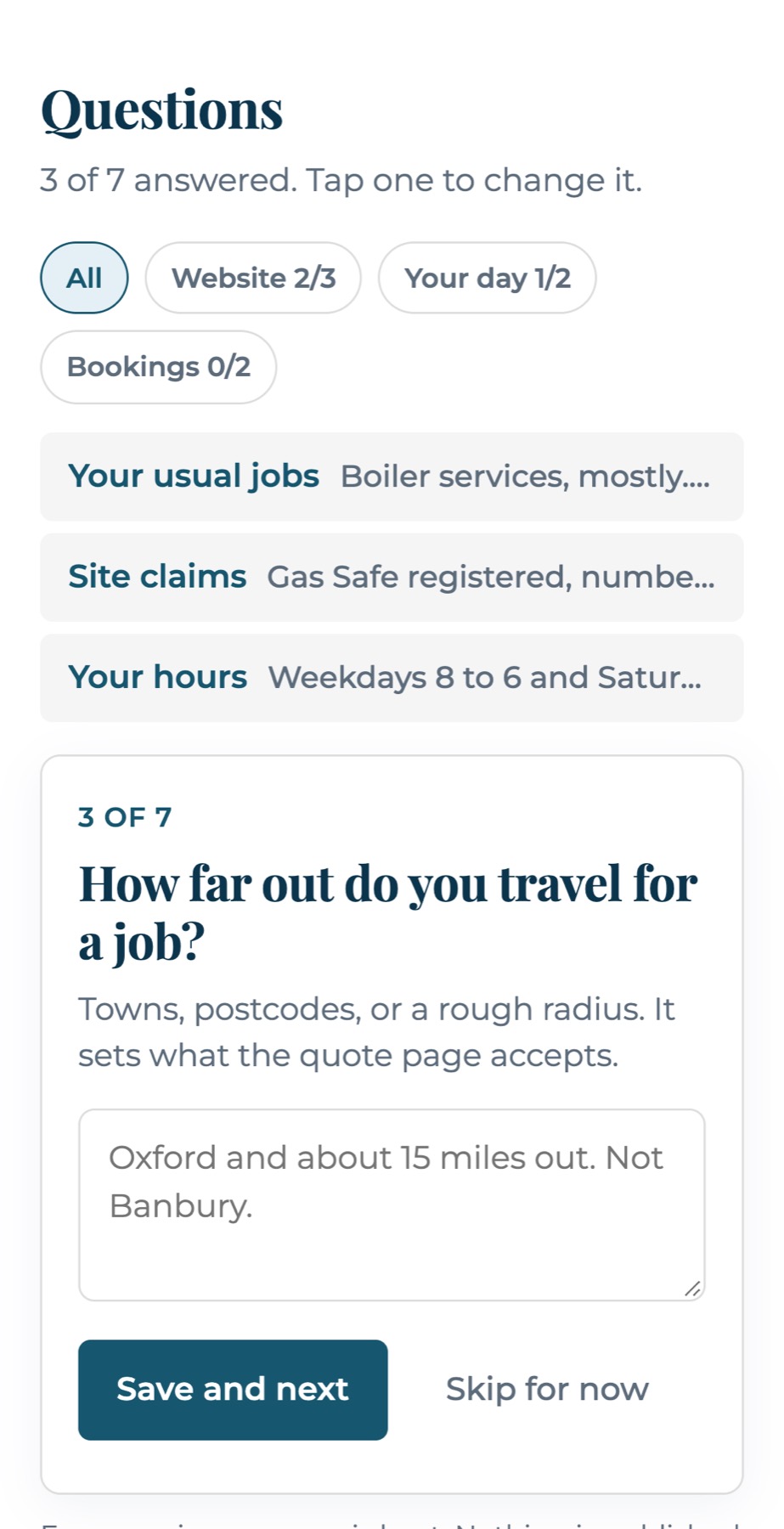
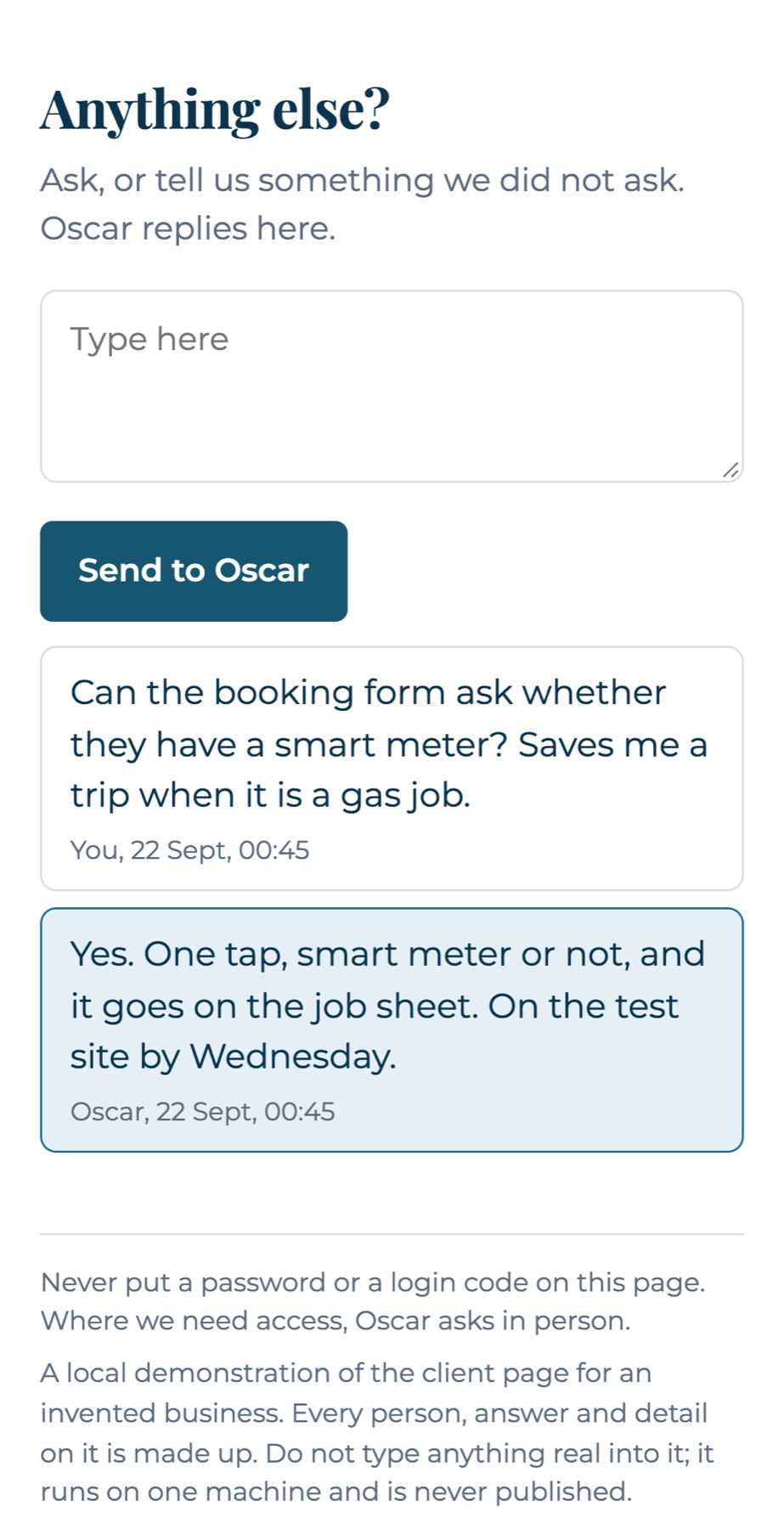
Your page, while I build.

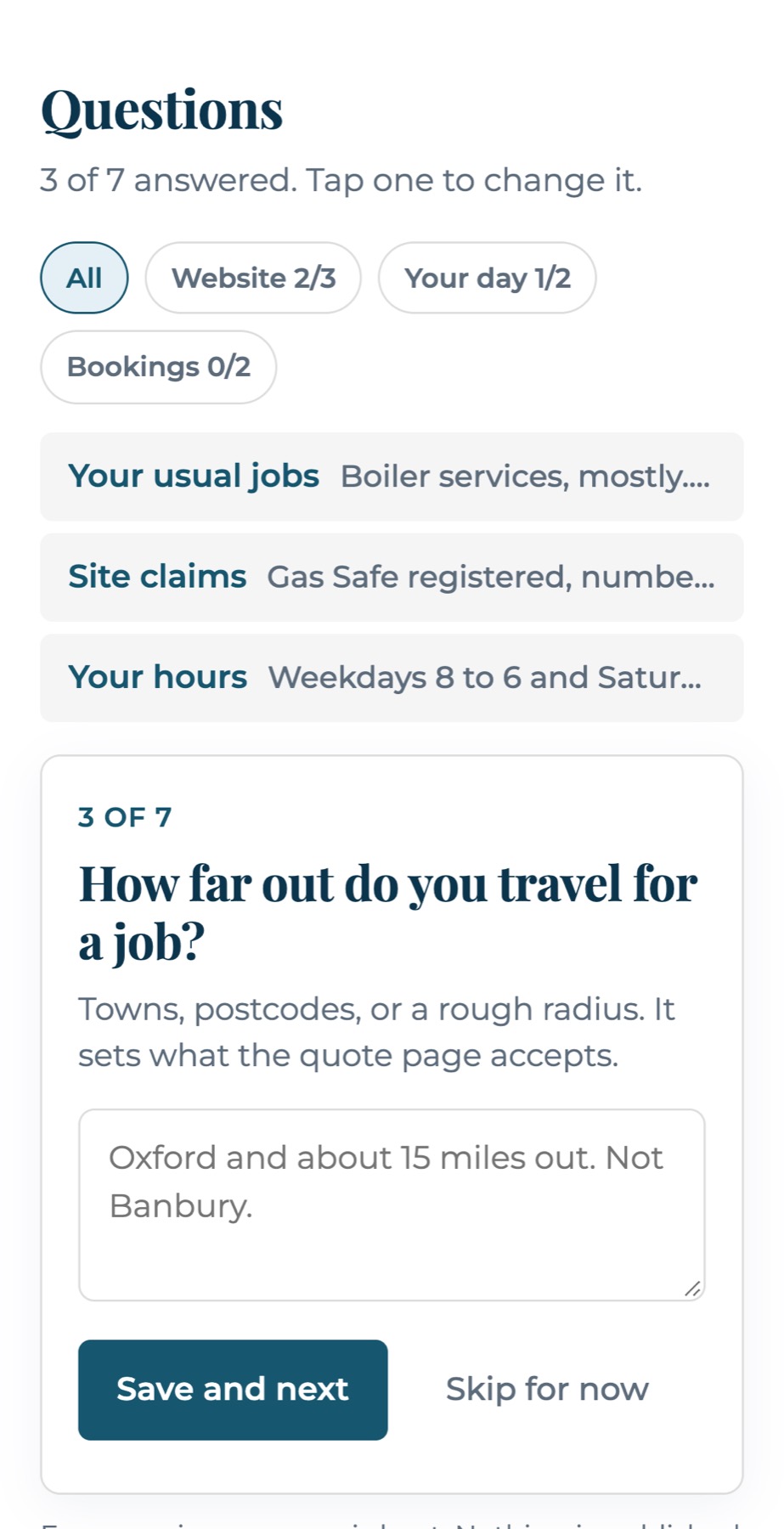
Every client gets one private link. What the build is waiting on, a short list of things only they can do, the questions one at a time, what happens next, and a place to ask anything. Screens from that page, running for an invented client. Nothing here is anyone real.

Hover a screen to look closer. Then hover a part of it. Scroll on to leave.

Fifty customers try a client's site every morning, before yours do.

Every morning a real browser plays 50 invented customers through it: a florist on her phone, a brewer with a spreadsheet, a grandmother sending a cake, a best man who taps everything twice. Every booking goes through the site to somewhere in London.

SohoShoreditchGreenwichBrixtonBethnal GreenAngelClaphamWestminsterKing's CrossCanary WharfBoroughBrockleyCamdenWaterlooWhitechapelHackneyAhmedAishaAmaraAnyaBeaBillConnorDevElenaFarahFionaGarethGraceHamidHollyIngridIsabelleJamalKofiKwameLeilaLucaMarcusMeiMollyNadiaOlamideOscar LPetePriyaRajRobSarahSofiaTheoTomaszVictorWeiYukiZaraArjunBenChloeDanielEmilyFatimaGeorgeLucyMargaretRosiethe site

Teal, a business. Amber, a person sending one thing. Inside, where it goes. The site in the middle, every booking through it.

50 people, 40 businesses and 10 individuals, 30 of them on phones, sending to 16 parts of London, every morning. Every stumble is written up, person by person. I hear about it only when one of them is stuck.

And this page? Check it yourself.

Nine of the same checks, run on this page, in your browser, right now.

This demonstration needs JavaScript.

    One person, in Oxford

    I'm Giles. I build and run this myself. No account manager, no handover to a junior. Every job is quoted after the audit; nothing is billed by the hour.

    I use AI tools all day and check everything they produce. Bots draft, you approve, and nothing goes live without a person looking at it.

    Checked 2026-09-22. 4 pages on 5 screen sizes, light and dark. No console errors, no sideways scroll, 0 requests to anyone else, every colour readable on all 5 screen sizes. Lighthouse phone 98 speed, 100 accessibility, 100 best practice, 100 search; desktop 100, 100, 100, 100. Not tested: screen readers.

    This page watches nobody

    No cookies. No analytics. No fonts from Google, no tracking pixel, no chat widget. No cookies, nothing kept in your browser. If you send the form, what you send is stored so I can reply, and the privacy notice says where. When you email me, your message sits in my mailbox. Nobody else is sent it. The full notice is short.

    Send me your website address

    The address and what you sell. I'll say whether there's something worth fixing. No list, no pitch.

    or email hello@oscarsai.co.uk

    I use what you send to reply, and for nothing else. It sits with Cloudflare until I read it, then on my own computer. Privacy notice.

    What I doSend your address